
Code with
Confidence.
Secure your web and mobile applications against sophisticated threats. We find the vulnerabilities automated tools miss.
OWASP Top 10 Coverage
We don't just check boxes. We rigorously test against the most critical security risks to web applications.
Broken Access Control
Restrictions on what authenticated users are allowed to do are often not properly enforced. Attackers can exploit these flaws to access unauthorized functionality and/or data, such as viewing other users' accounts, viewing sensitive files, or modifying other users' data.
Real-world Impact
Attackers can act as administrators, view sensitive records, or delete data.
Cryptographic Failures
Previously known as Sensitive Data Exposure. This category focuses on failures related to cryptography which often leads to sensitive data exposure or system compromise. Examples include transmitting data in clear text, using weak cryptographic algorithms, or weak key management.
Real-world Impact
Credit card theft, password leaks, and exposure of personal health information.
Injection
User-supplied data is not validated, filtered, or sanitized by the application. Common examples include SQL, NoSQL, OS command, Object Relational Mapping (ORM), LDAP, and Expression Language (EL) or OGNL injection. Attackers can use injection to access data without authorization.
Real-world Impact
Complete database takeover, data loss, or denial of service.
Insecure Design
A new category for 2021, focusing on risks related to design flaws. If we want to 'move left' as an industry, it calls for more use of threat modeling, secure design patterns, and reference architectures. An insecure design cannot be fixed by a perfect implementation.
Security Misconfiguration
Missing appropriate security hardening across any part of the application stack, or improperly configured permissions on cloud services. This includes unpatched systems, default accounts, unused pages, and unprotected files and directories.
Vulnerable Components
Components, such as libraries, frameworks, and other software modules, run with the same privileges as the application. If a vulnerable component is exploited, such as in a supply chain attack, it can facilitate serious data loss or server takeover.
Identification Failures
Confirmation of the user's identity, authentication, and session management is critical. Weaknesses here can allow attackers to compromise passwords, keys, or session tokens, or to exploit other implementation flaws to assume the identities of other users.
Real-world Impact
Account takeover, session hijacking, and identity theft.
Software & Data Integrity
Code and infrastructure that does not protect against integrity violations. This includes software updates, critical data, and CI/CD pipelines that are not verified. An attacker could upload their own updates to be distributed and run on all installations.
Real-world Impact
Malicious code injection via updates or compromised CI/CD pipelines.
Logging Failures
Security logging and monitoring failures coupled with missing or ineffective integration with incident response allows attackers to further attack systems, maintain persistence, pivot to more systems, and tamper, extract, or destroy data without detection.
Real-world Impact
Delayed breach detection, inability to trace attacker actions.
SSRF
Server-Side Request Forgery flaws occur whenever a web application is fetching a remote resource without validating the user-supplied URL. It allows an attacker to coerce the application to send a crafted request to an unexpected destination, often bypassing firewalls.
Real-world Impact
Access to internal services, cloud metadata theft, and RCE.
Broken Access Control
Restrictions on what authenticated users are allowed to do are often not properly enforced. Attackers can exploit these flaws to access unauthorized functionality and/or data, such as viewing other users' accounts, viewing sensitive files, or modifying other users' data.
Real-world Impact
Attackers can act as administrators, view sensitive records, or delete data.
Cryptographic Failures
Previously known as Sensitive Data Exposure. This category focuses on failures related to cryptography which often leads to sensitive data exposure or system compromise. Examples include transmitting data in clear text, using weak cryptographic algorithms, or weak key management.
Real-world Impact
Credit card theft, password leaks, and exposure of personal health information.
Injection
User-supplied data is not validated, filtered, or sanitized by the application. Common examples include SQL, NoSQL, OS command, Object Relational Mapping (ORM), LDAP, and Expression Language (EL) or OGNL injection. Attackers can use injection to access data without authorization.
Real-world Impact
Complete database takeover, data loss, or denial of service.
Insecure Design
A new category for 2021, focusing on risks related to design flaws. If we want to 'move left' as an industry, it calls for more use of threat modeling, secure design patterns, and reference architectures. An insecure design cannot be fixed by a perfect implementation.
Security Misconfiguration
Missing appropriate security hardening across any part of the application stack, or improperly configured permissions on cloud services. This includes unpatched systems, default accounts, unused pages, and unprotected files and directories.
Vulnerable Components
Components, such as libraries, frameworks, and other software modules, run with the same privileges as the application. If a vulnerable component is exploited, such as in a supply chain attack, it can facilitate serious data loss or server takeover.
Identification Failures
Confirmation of the user's identity, authentication, and session management is critical. Weaknesses here can allow attackers to compromise passwords, keys, or session tokens, or to exploit other implementation flaws to assume the identities of other users.
Real-world Impact
Account takeover, session hijacking, and identity theft.
Software & Data Integrity
Code and infrastructure that does not protect against integrity violations. This includes software updates, critical data, and CI/CD pipelines that are not verified. An attacker could upload their own updates to be distributed and run on all installations.
Real-world Impact
Malicious code injection via updates or compromised CI/CD pipelines.
Logging Failures
Security logging and monitoring failures coupled with missing or ineffective integration with incident response allows attackers to further attack systems, maintain persistence, pivot to more systems, and tamper, extract, or destroy data without detection.
Real-world Impact
Delayed breach detection, inability to trace attacker actions.
SSRF
Server-Side Request Forgery flaws occur whenever a web application is fetching a remote resource without validating the user-supplied URL. It allows an attacker to coerce the application to send a crafted request to an unexpected destination, often bypassing firewalls.
Real-world Impact
Access to internal services, cloud metadata theft, and RCE.
Mobile vs. Web: Distinct Threats
Securing a mobile app requires a completely different mindset than a web app. While they often share a backend, the client-side risks are fundamentally different.
Web Application Security
Web security focuses heavily on the server-side and the browser environment. The client (browser) is trusted to render content but untrusted to enforce security. Attacks often exploit how the browser handles data (XSS) or how the server processes input (SQLi).
- Injection AttacksSQLi, Command Injection, and LDAP Injection targeting the backend database.
- Cross-Site Scripting (XSS)Executing malicious scripts in the victim's browser to steal sessions.
- Broken Access ControlBypassing authorization checks to access other users' data (IDOR).
Mobile App Security
Mobile security assumes the device itself might be hostile (jailbroken/rooted). The attacker has full access to the binary, local storage, and memory. Security relies on hardening the app against reverse engineering and securing the API it talks to.
- Insecure Data StorageLeaving sensitive data (tokens, PII) in unencrypted local files (SharedPreferences, Plist).
- Code TamperingModifying the app binary to bypass premium checks or root detection.
- Hardcoded SecretsEmbedding API keys or encryption keys directly in the app code.
Attack Surface Comparison
| Feature | Web Application | Mobile Application |
|---|---|---|
| Environment | Controlled by Server (mostly) | Controlled by User (Hostile Device) |
| Source Code | Hidden on Server (Backend) | Publicly Available (APK/IPA Decompilation) |
| Network | HTTPS (Standard CA Trust) | HTTPS + SSL Pinning Required |
| Primary Risk | Remote Exploitation (SQLi, RCE) | Local Compromise & API Abuse |
Anatomy of a Vulnerability
Understanding the root cause is the first step to remediation. Here is how we identify and fix common high-risk flaws.
SQL Injection (SQLi)
SQL Injection occurs when untrusted user input is directly concatenated into a database query. This allows attackers to manipulate the query structure, potentially accessing, modifying, or deleting sensitive data.
Attack Vector
Attackers inject malicious SQL commands via input fields, URL parameters, or HTTP headers. For example, entering `' OR '1'='1` into a login field can bypass password checks.
Remediation
Use parameterized queries (Prepared Statements) for all database access. This ensures the database treats user input as data, not executable code. Additionally, implement strict input validation and least privilege database accounts.
// VULNERABLE: Direct concatenation
const query = "SELECT * FROM users WHERE username = '" + username + "'";
db.execute(query);// SECURE: Parameterized queries
const query = "SELECT * FROM users WHERE username = ?";
db.execute(query, [username]);The Testing Workflow
A comprehensive approach combining automated precision with human ingenuity.
Reconnaissance & Threat Modeling
Before a single packet is sent, we perform extensive reconnaissance to understand your application's footprint. We map out the attack surface, identify subdomains, enumerate API endpoints, and analyze the technology stack. We then build a threat model specific to your business logic, identifying high-value targets and potential abuse scenarios.
Static Analysis (SAST)
We perform a deep-dive analysis of your source code, bytecode, or binary code to identify security vulnerabilities without executing the application. This 'white-box' approach allows us to catch issues like hardcoded credentials, insecure cryptographic implementations, and buffer overflows early in the development lifecycle, reducing the cost of remediation.
Dynamic Analysis (DAST)
We interact with the running application to identify vulnerabilities that only appear at runtime. This 'black-box' or 'gray-box' testing simulates a real-world attacker, probing for authentication bypasses, server misconfigurations, session management flaws, and injection points that SAST might miss.
[+] Port 443: Open
[!] SQL Injection found in /login
Manual Logic Testing
Automated tools cannot understand the context of your application. Our expert pentesters manually probe for complex business logic flaws, such as bypassing authorization controls (IDOR), manipulating payment flows, or exploiting race conditions. This human intelligence is critical for uncovering high-impact vulnerabilities.
Reporting & Remediation
We don't just hand you a PDF and walk away. We provide a comprehensive report detailing every finding with reproduction steps, impact analysis, and developer-ready remediation code. We then work with your team to verify fixes and ensure no regressions were introduced.
Security at the Speed of DevOps
Traditional security testing is a bottleneck. We "Shift Left," integrating automated security checks directly into your CI/CD pipeline. This ensures vulnerabilities are caught early, when they are cheapest to fix.
SAST (Static Analysis)
We scan your source code for insecure patterns (e.g., hardcoded secrets, SQLi vectors) before it even compiles.
DAST (Dynamic Analysis)
Automated attacks against your running application in staging to find runtime flaws like XSS and auth bypasses.
SCA (Software Composition Analysis)
Identifying vulnerable third-party libraries (e.g., outdated npm packages) to prevent supply chain attacks.
$ running SAST (SonarQube)...
✓ No critical vulnerabilities found
$ running DAST (OWASP ZAP)...
✓ Endpoint security verified
$ running SCA (Snyk)...
✓ Dependencies secure
Technologies We Secure
From legacy monoliths to modern microservices, we have the expertise to test your entire stack.
Web Frameworks
Mobile Platforms
Cloud & Infrastructure
API & Backend
Compliance Ready
Our application penetration tests are designed to satisfy the rigorous requirements of major compliance frameworks.
PCI DSS 4.0
Requirement 6.5 addresses common coding vulnerabilities. Our testing specifically validates controls against injection flaws, buffer overflows, insecure cryptographic storage, and other critical risks mandated by the Payment Card Industry.
HIPAA / HITECH
For healthcare applications, we focus on the Technical Safeguards of the Security Rule. We test for proper encryption of ePHI at rest and in transit, access controls, and audit logging integrity to prevent unauthorized disclosure of patient data.
SOC 2 Type II
Our pentesting reports serve as critical evidence for your SOC 2 audit, specifically addressing the Security, Availability, and Confidentiality trust service criteria. We verify that your logical access controls are functioning as designed.
GDPR
Under Article 32, organizations must implement technical measures to ensure security. We help you demonstrate 'state of the art' security practices by identifying and mitigating vulnerabilities that could lead to a data breach.
Your Application's
Security Blueprint.
We deliver more than just a vulnerability scan. You get a complete security blueprint for your application, mapping every flaw to OWASP standards with developer-ready remediation code.
OWASP Top 10 Mapping
Clear categorization of risks against global standards.
API Logic Analysis
Deep dive into broken object level authorization (BOLA).
Mobile & Web Coverage
Unified reporting for iOS, Android, and Web assets.
Developer-Ready Fixes
Copy-paste code snippets to patch vulnerabilities fast.
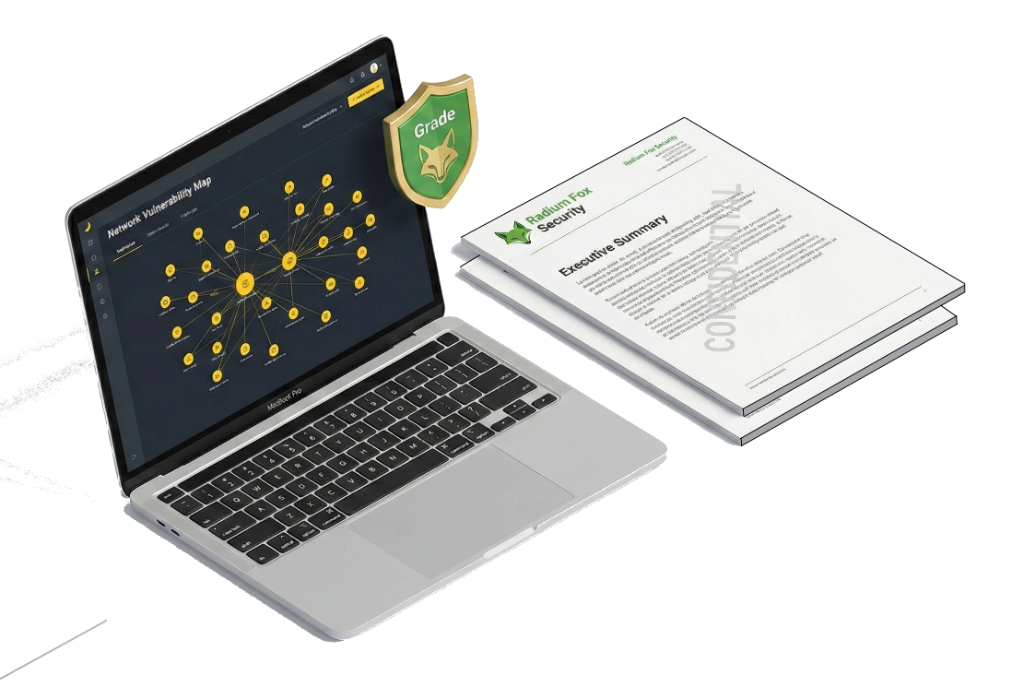
More Than Just a
PDF Report.
We provide a comprehensive remediation roadmap. Our reports bridge the gap between executive risk management and developer-focused technical fixes.
Executive Summary
Clear risk assessment for stakeholders, translated into business impact.
Technical Deep Dive
Step-by-step reproduction steps, PoC code, and exact file locations.
Remediation Roadmap
Prioritized fixes with code snippets and configuration changes.
The authentication parameter 'username' is vulnerable to time-based blind SQL injection.
AppSec FAQ
Answers to common questions about our methodology, scope, and deliverables.
Join Us. Cut Costs.
Focus on What Matters.
Unlock high-impact penetration testing that drives real security gains. Led by experts, tailored for results, and designed to stay budget-friendly.
Submit Info
Share your environment, scope, or compliance needs via our quick form.
Senior Review
A lead RadiumFox engineer reviews and tailors your assessment—no junior handoffs.
Optional Scoping Call
We'll clarify priorities and technical details if needed.
Clear Quote
Expect a fixed-cost proposal—no hidden fees or fluff.
Fast Kickoff
Once approved, most projects launch within 5–7 business days with full support.